Every alert is a yes no vote
The number on the dashboard is the answer to a question you didn't ask.
The number on the dashboard is the answer to a question you didn't ask.
An alert fires. Someone looks at it. They decide: act, or don't. That decision takes between thirty seconds and fifteen minutes, and it costs the operator attention they will not get back. Three hundred alerts a day is three hundred votes on whether the on-call engineer can finish their lunch.
This is why we stop counting alerts and start counting decisions. The question the dashboard is actually asking is not "what is the temperature in plant room three" — it is "should a human do something about it". Every tile, every threshold, every notification is a yes-no vote. The system either earns the operator's attention or it spends it.
The budget is the unit
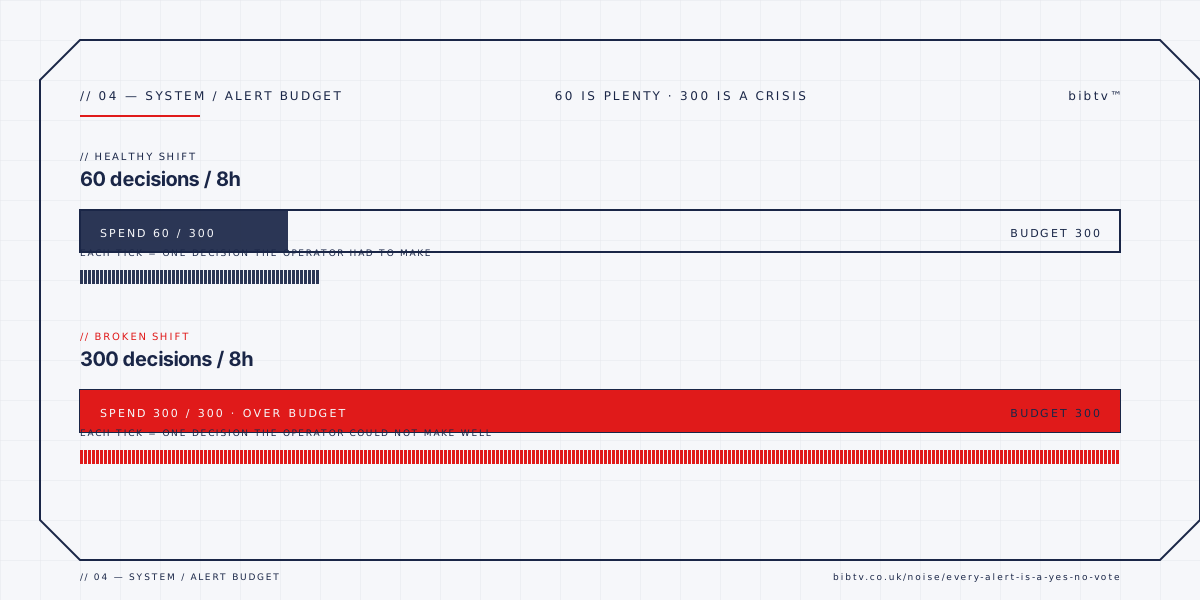
We work in alert budgets. A team gets a fixed number of decisions per shift — sixty is plenty, three hundred is a crisis. The job of the system is to keep the spend inside the budget. If the spend goes over, the system is broken, not the team. You don't fix a broken system by telling the team to be faster at deciding.
This flips the usual conversation. Instead of "is the alert right", the question becomes "did this alert earn its slot in the budget". An alert that is right but obvious — the system already knows the answer — is still a wasted vote. An alert that is wrong and obvious — the system has fired on a known-bad condition — is a wasted vote and a trust withdrawal. The operator will start ignoring the channel.
The signals that earn their slot are the ones that change behaviour. "Pump two is drawing four times its rated current" earns a slot because the operator's response is to dispatch a tech. "CO2 has risen by 50 ppm in the last hour" is a trend, not an alert. It belongs on a graph, not in a notification.
What we do differently
We do not optimise for fewer alerts. We optimise for fewer useless alerts. Cutting alerts in half by raising thresholds usually means cutting useful signal in half along with the noise.
What we do is push alerts to the bottom of the stack. The first thing an operator sees is the decision, not the data. The data is one click away. The decision is the contract: "act" or "don't", with the reason on the same line. If the operator has to read three widgets to figure out what to do, the system has failed.
The second thing we do is time-box the response. Every alert has a window — five minutes to acknowledge, fifteen to act, sixty to resolve. If the window expires, the alert escalates, not because the system is angry, but because the question is now "do we need more people on this" rather than "should someone look at this".
The small business unit
Every connected device is a small business. It has revenue — the data it produces, the decisions it enables. It has costs — the connectivity, the maintenance, the human attention it consumes. Most teams do not think of a temperature sensor as a P&L line, but every alert it fires is a withdrawal, and every alert that is acted on is a return.
The job of a well-built IoT system is to make every device profitable at the level of attention. The number of devices grows linearly. The number of humans does not. Treat attention as the scarce resource, and the device as a customer of it.