
The zero-hype framework
Most enterprise AI fails an engineering test, not a business test. Three filters, applied in order, kill most of it before any code is written.
Right now, enterprise AI is suffering from an expensive identity crisis. Boards want "AI integration" on the roadmap; few can define what that means for the bottom line. The result is generic LLMs bolted on to problems a well-structured database, a regression, or a hard-coded business rule could have fixed in an afternoon.
The compute bills, the hallucinated data, the sandboxes that never ship — they are symptoms of one mistake: starting with the model, not the problem.
We don't deal in tech-evangelism. We approach AI from the perspective of systems engineers. AI isn't magic; it's an optimisation layer for existing infrastructure. To deploy it honestly, we run every proposed initiative through a rigid three-layer filter. If a project fails any layer, we kill it.
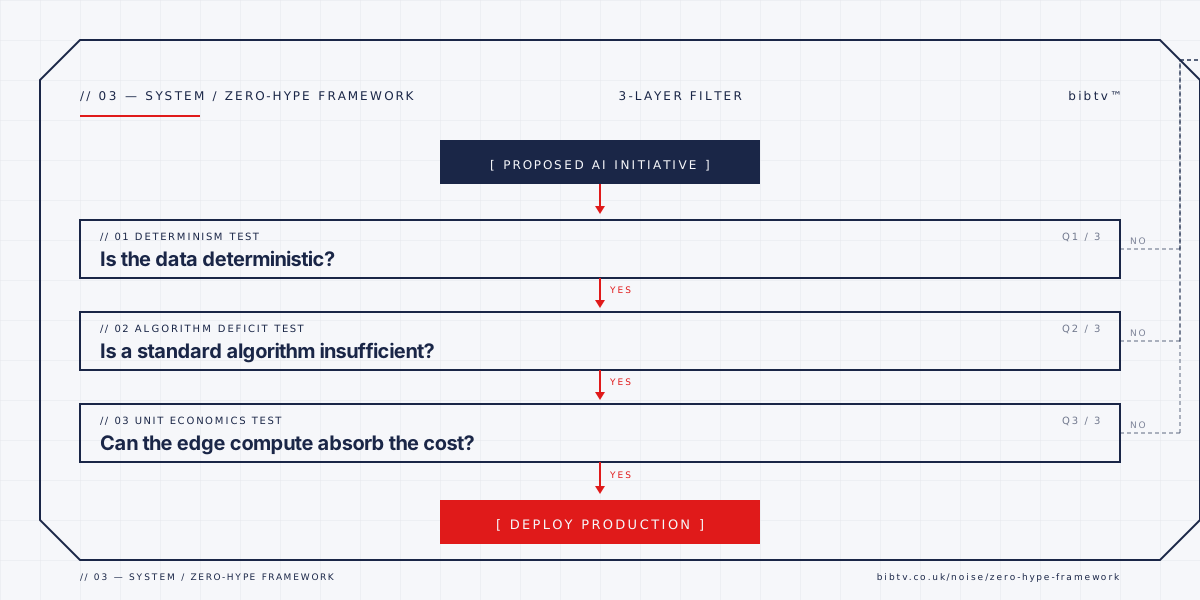
The core filter
1. The determinism test. Does the task require a mathematically verifiable true/false answer, or does it thrive on probabilistic patterns? Predictive maintenance on a manufacturing line cannot afford a model that guesses with creative variance. Anchor AI where probability is an asset — pattern matching, anomaly detection, semantic search — and keep rigid, deterministic logic deterministic.
2. The algorithm deficit test. Can this be solved with classical statistics, standard regression, or hard-coded business logic? Throwing a generative LLM at a problem a deterministic algorithm could solve is like using a rocket engine on a lawnmower. The framework mandates the simplest mathematical tool that works.
3. The unit economics test. What is the literal energy, tokens, and compute cost per call, and does the operational lift justify it? Cloud-hosted massive models compound platform fees fast. We look for a highly compressed, open-source model running on local edge infrastructure — no API dependencies, no data leak surface. If the math doesn't work on day one, it won't work at scale.
From wrappers to infrastructure
The market is flooded with AI wrappers — surface-level chat interfaces on top of third-party APIs. Those are marketing tools, not enterprise assets. We build intelligent infrastructure. Data flows from the physical edge, through schemas, into specialised local models.
| Phase | Hype approach | bibtv approach |
|---|---|---|
| Strategy | "Let's build a custom chatbot." | Identify operational bottlenecks. |
| Model | Closed-source, massive, unpredictable. | Small, specialised, self-hosted. |
| Data | Raw text into a prompt. | Rigid schemas + structured vector DBs. |
| Outcome | High latency, high cost, low security. | Edge-optimised, zero-leakage. |
The best technology doesn't shout. Deployed correctly, AI sits quietly in the background of the infrastructure, filtering the noise of millions of IoT data points and flagging a failing sub-component before it breaks.
Filter the noise. Protect the margins. Architect the signal.